
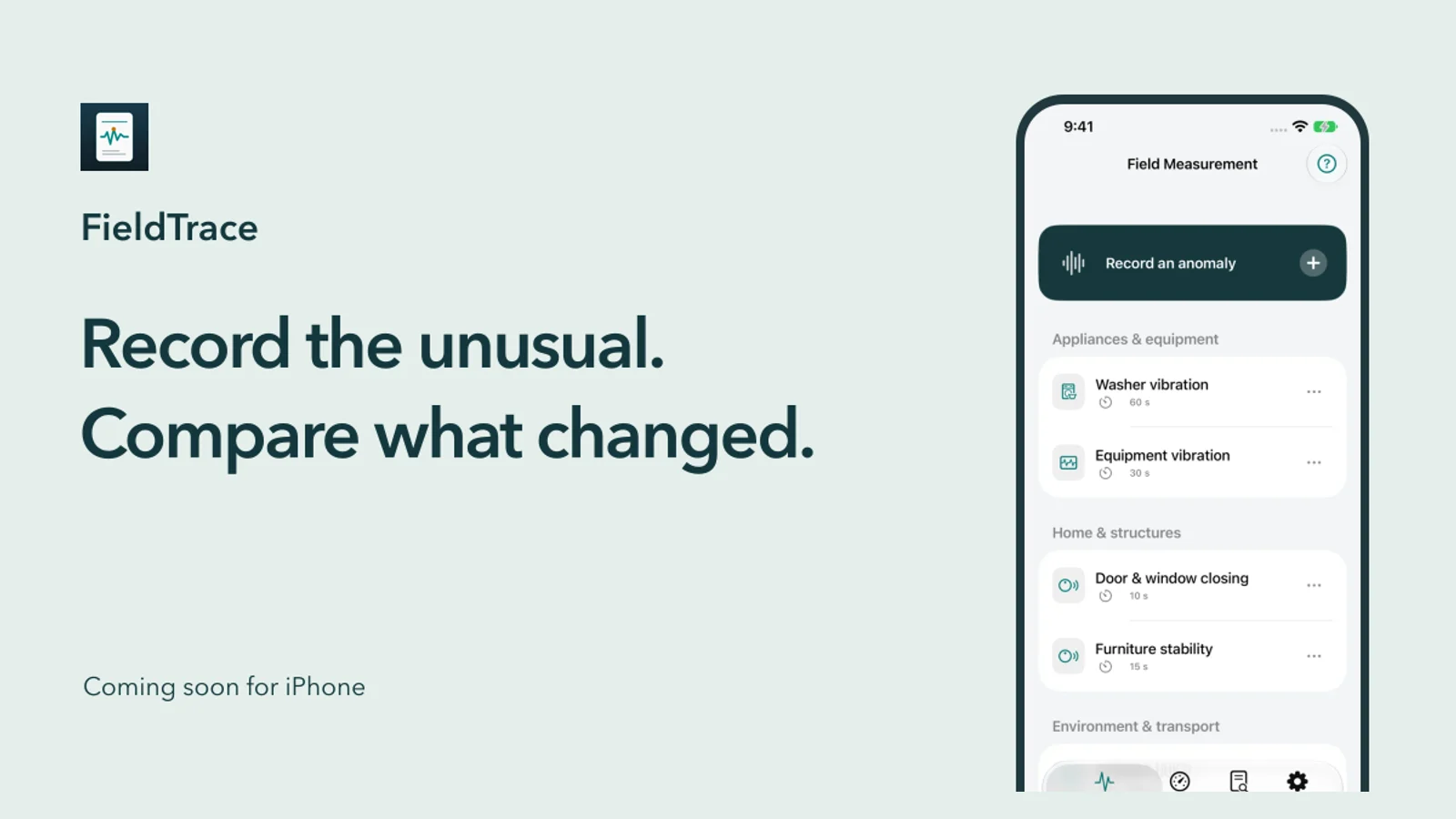
That rattle happened again. Was the vibration there before the adjustment? A fleeting symptom is difficult to explain from memory, especially when someone else needs to investigate it later. FieldTrace is an upcoming iPhone app built around that gap: keep the recording and its context, revisit the moment, and compare a repeat test.
A useful record begins with what happened
A recording without its conditions can be difficult to interpret. The object, phone placement and what you were doing matter when you return to it later. FieldTrace keeps these details with the session so the next test has a meaningful starting point.
From something unusual to something you can review.
- Keep the context — Choose a scenario, note the object and its conditions, secure the phone and start recording before reproducing the issue.
- Find the moment — Add a marker while recording. Later, inspect candidate events, surrounding sound and vibration, and your on-site notes.
- Check the change — Repeat with the same setup. Compare the records and share a PDF or CSV when someone else needs the details.
Go back to the moment that matters.
A peak alone rarely tells the whole story. Inspect what happened before and after it, with sound, vibration and your own observations on one timeline.
Alongside the timeline, FFT spectrum analysis helps you inspect recurring frequency components. Live vibration spectra and post-recording analysis help review what repeats and at which frequencies. A spectral peak is a clue to investigate, not an automatic diagnosis of a component or fault.
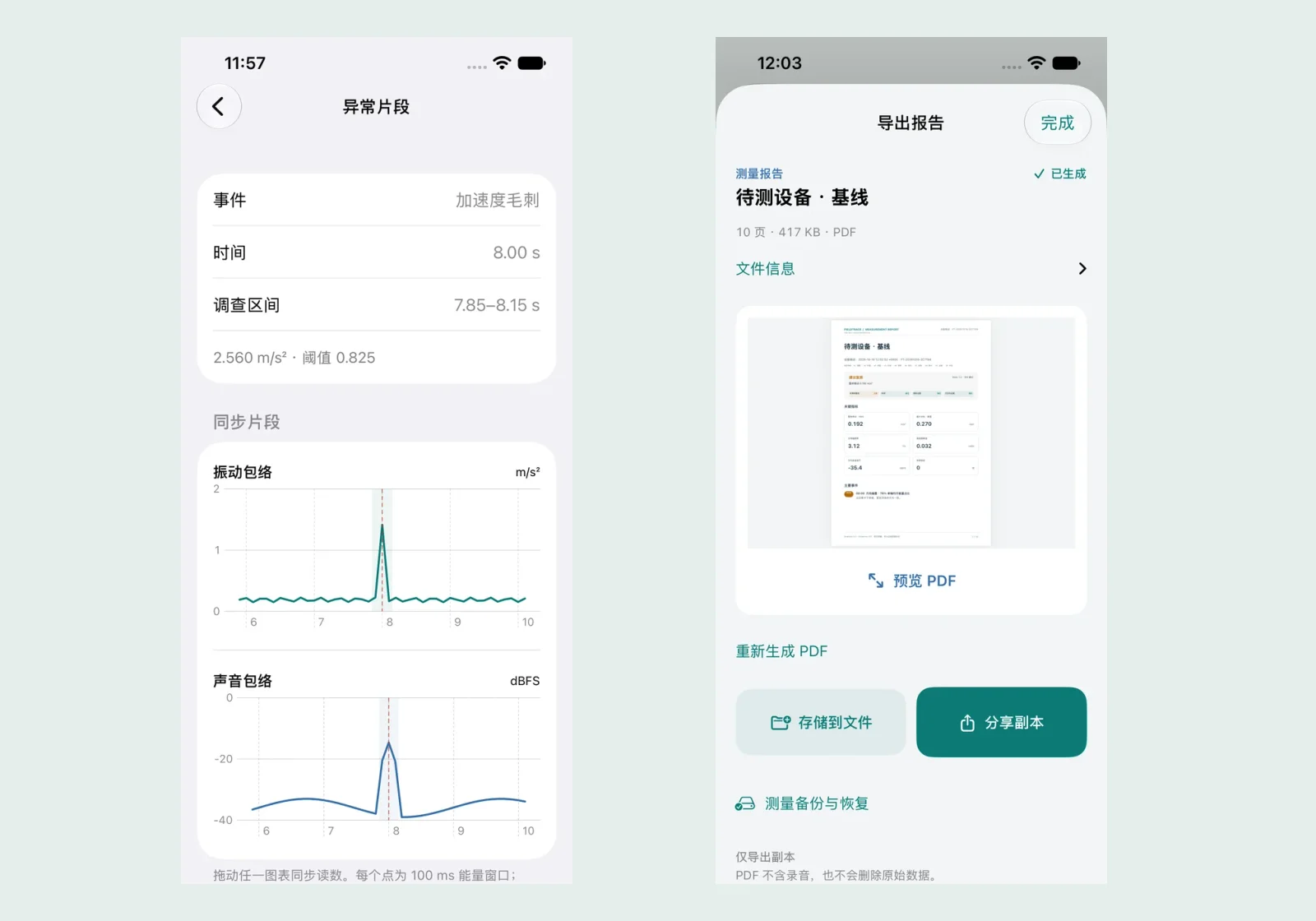
Actual Simplified Chinese app interface showing an event timeline and the report export workspace. All signals shown are example data.
An adjustment deserves a fair comparison.
A lower number alone does not establish that an adjustment worked. Keep the object, placement and operating conditions consistent, then review the two records together. Comparability checks help expose changes in the setup; interpreting the result still requires judgment.
Give the next person more than “it felt different.”
Share a readable PDF with the record and its context, export CSV for further analysis, or keep a portable backup for another device.
No account is required for local recording and review. Saved measurements stay on the device until you choose to export or share them. Raw audio is saved only when you enable it.
A separate workspace for vehicle acceleration.
Prepare the run, wait for readiness and review whether the result has enough evidence. Keep incomplete runs visible and pair a result with an external reference when needed.
For controlled, legal test environments. Phone-only timing is a reference, not certified timing; real-vehicle accuracy validation is still pending.
Before you start
FieldTrace documents observations and helps you investigate them. Candidate events are prompts for review, not fault diagnoses. A session must be started before the issue is reproduced, with the app in the foreground and the phone secured.
The first App Store release is being prepared. The app and reports support English, Simplified Chinese, Traditional Chinese, Japanese and Korean. Pricing and availability have not been announced.